Breaking
How attackers got into Osaki Electric: a VPN account without MFA and repeated password attempts at 1:30 a.m.Algonquin Dam cyberattack attempt: Illinois says staff blocked unauthorized access and kept full control of the Fox River damHow the Equinor and Skagerak Energi attacks happened: an Azure API Management flaw, Norway's NSM saysJava4Shell reaches the plant floor: Siemens Industrial Edge and Ignition SCADA exposed to CVE-2026-114938, with no Siemens fix yetRansomware halts smart meter production at Osaki Electric, the top meter supplier to Japan's power utilitiesEquinor hit by an "ongoing" cyber-attack as Norway's energy giant moves to neutralise the intrudersA perfect-10 SCADA flaw found by AI: the Circutor PowerStudio exploit sat on GitHub for three months before it got a CVEThe chlorine alarm went out by email just as Microsoft went down: 15 guests hurt at a German hotel pool1,266 ransomware attacks on industry in one quarter. Not one reached a control system, and plants stopped anywaySix new zero-days in the fridge controllers hit in Europe's supermarket attacks. Germany's BSI: patching is not enoughA supermarket fridge supervisor ran the login name as a shell command. Attackers hit one flaw 100 minutes after it went publicFBI: an AI hacking tool takes attackers from first scan to privileged access in under three hoursMalware planted on a German military drone maker's update server. The Bundeswehr reportedly grounded the dronesOff-the-shelf AI found 66 new bugs in the network code inside OT devices. Nine months of work took 90 hoursAttackers gave an AI framework one line of instructions. It broke into 10 organizations, Unit 42 saysHow attackers got into Osaki Electric: a VPN account without MFA and repeated password attempts at 1:30 a.m.Algonquin Dam cyberattack attempt: Illinois says staff blocked unauthorized access and kept full control of the Fox River damHow the Equinor and Skagerak Energi attacks happened: an Azure API Management flaw, Norway's NSM saysJava4Shell reaches the plant floor: Siemens Industrial Edge and Ignition SCADA exposed to CVE-2026-114938, with no Siemens fix yetRansomware halts smart meter production at Osaki Electric, the top meter supplier to Japan's power utilitiesEquinor hit by an "ongoing" cyber-attack as Norway's energy giant moves to neutralise the intrudersA perfect-10 SCADA flaw found by AI: the Circutor PowerStudio exploit sat on GitHub for three months before it got a CVEThe chlorine alarm went out by email just as Microsoft went down: 15 guests hurt at a German hotel pool1,266 ransomware attacks on industry in one quarter. Not one reached a control system, and plants stopped anywaySix new zero-days in the fridge controllers hit in Europe's supermarket attacks. Germany's BSI: patching is not enoughA supermarket fridge supervisor ran the login name as a shell command. Attackers hit one flaw 100 minutes after it went publicFBI: an AI hacking tool takes attackers from first scan to privileged access in under three hoursMalware planted on a German military drone maker's update server. The Bundeswehr reportedly grounded the dronesOff-the-shelf AI found 66 new bugs in the network code inside OT devices. Nine months of work took 90 hoursAttackers gave an AI framework one line of instructions. It broke into 10 organizations, Unit 42 says
Consulting site
ICS Cyber News
Monday, 16 November 2026, Israel time

The chlorine alarm went out by email just as Microsoft went down: 15 guests hurt at a German hotel pool

The automatic dosing system at the pool of Hotel Ling Bao, part of the Phantasialand theme park in Brühl near Cologne, pumped far too much chlorine into the water. The monitoring system noticed and raised the alarm. By email. On Friday 13 November Microsoft's email services were down, and the warning never reached anyone.
16 Nov 2026, Israel time
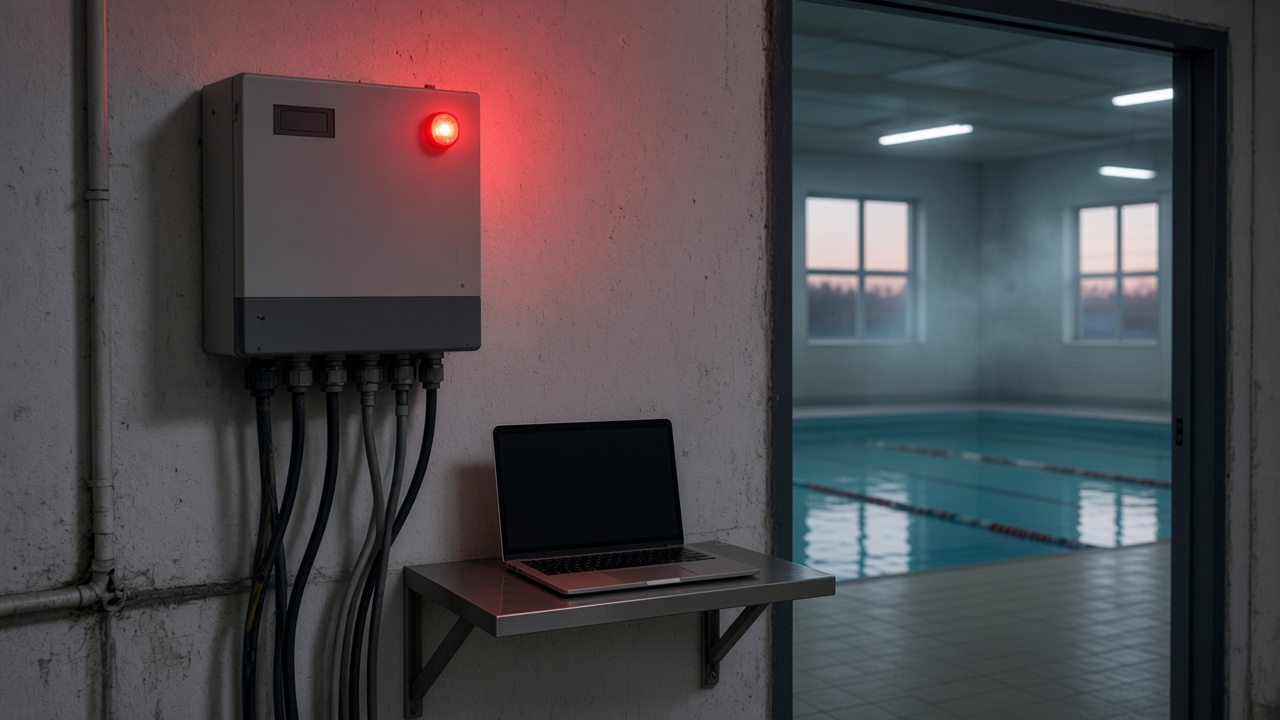
An empty indoor pool plant room, a wall controller with a red lamp, and a dark laptop. Illustration.
Illustration

So, as the park told WDR, nobody knew anything was wrong until guests started to complain.

What happened at the pool

It happened on Friday afternoon. Hotel guests reported health problems after using the pool, and paramedics and the fire brigade were called. At first 13 guests reported irritated airways; the number later rose to 15. Four were taken to hospital (five at first, later corrected), and one stayed in for observation with a moderate injury.

According to the Brühl fire brigade, quoted by heise, the overdose led to chlorine gas escaping in the pool area. About 40 responders spent roughly two hours on site. Tests by the emergency crews found a defect in the pool's automatic dosing system, which had pushed the chlorine level well above normal. The water was replaced and the pool has reopened.

The Microsoft link

On Saturday the park confirmed to WDR that the incident was tied to the wide Microsoft disruption that hit Outlook among other services. heise reports Microsoft's cloud services were down from Thursday afternoon until at least Friday midday. None of the reports mention an attack. This was an outage, plus a design that didn't plan for one.

heise adds a side note: since Friday, phishing mails have been using the outage as bait, urging people to quickly delete supposedly held-back messages.

Cyber consultant Ilan Shaya notes that this is the kind of scenario risk reviews tend to miss. "Everyone asks what happens if a sensor fails. Very few sites ask what happens when the path that carries the alarm to a human disappears for a whole day."

What the neighbours do

WDR also spoke to Max Wiesen, who runs the Mauritius hotel and thermal spa in the region. The first thing he did after hearing the news, he said, was ask his technician Ingo Braun how well they were covered. They measure water values three times a day and have a simple alarm: if a pool is over or under chlorinated, a red lamp comes on so everyone knows.

Cybersecurity architect Stephan Skrobisch told WDR he doesn't blame Microsoft. In his view the fault lies in how the system was set up. No second alerting mechanism was put in, an acoustic signal for example, and a warning system meant to protect people must not depend on an email inbox alone.

Chemical dosing that alerts by email

Automatically controlled chemical dosing runs in water treatment, cooling towers, hospitals and factories. Plenty of these systems, especially at smaller sites, send their alarms by email or through a cloud app because it's cheap and quick to set up. Works fine, right up to the day one outside service goes down.

Shaya adds that in control systems (OT) the safety layer is normally kept apart from the control layer, and a safety alarm should keep working when the IT network, the internet and the cloud are all unavailable.

How many of your site's alarms would still reach a person if email and the cloud were down for a full day?

ICS Cyber News by email

Flashes and digests for the topics you pick. No ads.

Language
Frequency
Topics

Edited by Ilan Shaya with AI assistance