Breaking
How attackers got into Osaki Electric: a VPN account without MFA and repeated password attempts at 1:30 a.m.Algonquin Dam cyberattack attempt: Illinois says staff blocked unauthorized access and kept full control of the Fox River damHow the Equinor and Skagerak Energi attacks happened: an Azure API Management flaw, Norway's NSM saysJava4Shell reaches the plant floor: Siemens Industrial Edge and Ignition SCADA exposed to CVE-2026-114938, with no Siemens fix yetRansomware halts smart meter production at Osaki Electric, the top meter supplier to Japan's power utilitiesEquinor hit by an "ongoing" cyber-attack as Norway's energy giant moves to neutralise the intrudersA perfect-10 SCADA flaw found by AI: the Circutor PowerStudio exploit sat on GitHub for three months before it got a CVEThe chlorine alarm went out by email just as Microsoft went down: 15 guests hurt at a German hotel pool1,266 ransomware attacks on industry in one quarter. Not one reached a control system, and plants stopped anywaySix new zero-days in the fridge controllers hit in Europe's supermarket attacks. Germany's BSI: patching is not enoughA supermarket fridge supervisor ran the login name as a shell command. Attackers hit one flaw 100 minutes after it went publicFBI: an AI hacking tool takes attackers from first scan to privileged access in under three hoursMalware planted on a German military drone maker's update server. The Bundeswehr reportedly grounded the dronesOff-the-shelf AI found 66 new bugs in the network code inside OT devices. Nine months of work took 90 hoursAttackers gave an AI framework one line of instructions. It broke into 10 organizations, Unit 42 saysHow attackers got into Osaki Electric: a VPN account without MFA and repeated password attempts at 1:30 a.m.Algonquin Dam cyberattack attempt: Illinois says staff blocked unauthorized access and kept full control of the Fox River damHow the Equinor and Skagerak Energi attacks happened: an Azure API Management flaw, Norway's NSM saysJava4Shell reaches the plant floor: Siemens Industrial Edge and Ignition SCADA exposed to CVE-2026-114938, with no Siemens fix yetRansomware halts smart meter production at Osaki Electric, the top meter supplier to Japan's power utilitiesEquinor hit by an "ongoing" cyber-attack as Norway's energy giant moves to neutralise the intrudersA perfect-10 SCADA flaw found by AI: the Circutor PowerStudio exploit sat on GitHub for three months before it got a CVEThe chlorine alarm went out by email just as Microsoft went down: 15 guests hurt at a German hotel pool1,266 ransomware attacks on industry in one quarter. Not one reached a control system, and plants stopped anywaySix new zero-days in the fridge controllers hit in Europe's supermarket attacks. Germany's BSI: patching is not enoughA supermarket fridge supervisor ran the login name as a shell command. Attackers hit one flaw 100 minutes after it went publicFBI: an AI hacking tool takes attackers from first scan to privileged access in under three hoursMalware planted on a German military drone maker's update server. The Bundeswehr reportedly grounded the dronesOff-the-shelf AI found 66 new bugs in the network code inside OT devices. Nine months of work took 90 hoursAttackers gave an AI framework one line of instructions. It broke into 10 organizations, Unit 42 says
Consulting site
ICS Cyber News
Monday, 16 November 2026, Israel time

A supermarket fridge supervisor ran the login name as a shell command. Attackers hit one flaw 100 minutes after it went public

VulnCheck disclosed 14 vulnerabilities in XWEB EVO, the Dixell refrigeration supervisor now sold under Copeland. Each was proven to root access in a lab rebuilt from the vendor's firmware, and two are already exploited in the wild.
16 Nov 2026, Israel time
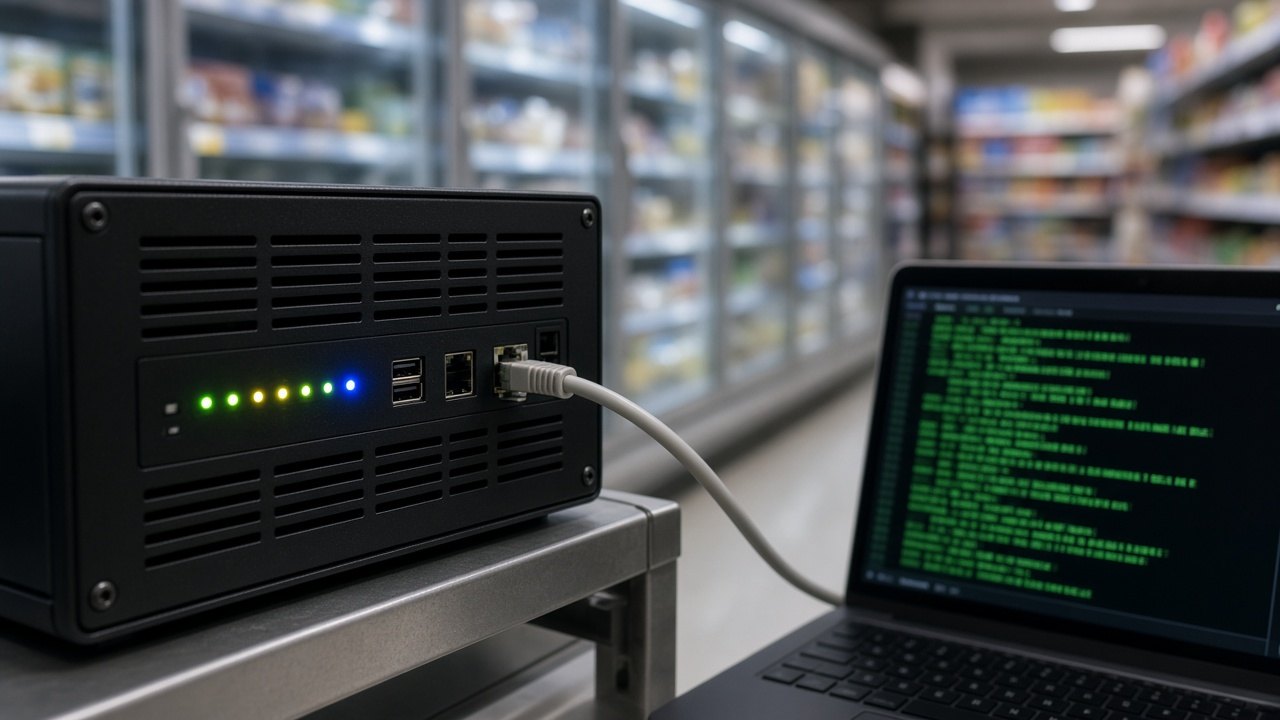
A generic refrigeration supervisor appliance beside a laptop in a supermarket. Illustrative, AI-generated. No logos.
Illustration
Copeland says patches are available and urges customers to keep the devices off the public internet. Legacy versions remain exposed to takeover, and the current 5.8.8 firmware is end-of-support.
“The login page runs the submitted username as a shell command before it ever checks the password.”VulnCheck, 13 November 2026

Fourteen flaws, each to root

VulnCheck disclosed 14 vulnerabilities in XWEB EVO, the supervisor that runs the refrigeration estate from a supermarket back office. All 14 got IDs through VulnCheck's CNA, from CVE-2026-124002 to CVE-2026-124015, and each was taken all the way to root in labs rebuilt from the vendor's firmware.

XWEB is not a random pick. CERT-FR named Copeland and Dixell XWEB as one of four controller families compromised in the night of 11 to 12 October, when about 700 French supermarkets had their refrigeration forced into defrost. In at least 15 stores the overloaded units caught fire. France attributed the campaign to the IRGC on 9 November.

Exploited within hours

The NVD record for CVE-2026-124014, an unauthenticated write of the system configuration file, went live on 12 November at 22:18 Israel time, with no exploit and no public proof of concept. By midnight, VulnCheck's canary sensors were recording exploitation: 87 hits in the first hour from a single source.

At 05:41 Israel time on 13 November, a second source began probing CVE-2026-124010. VulnCheck added both to its KEV list.

The login that runs your username

CVE-2026-124002 sits in login.lua. To look up the username, the script builds a find command and pastes the raw parameter into it with no escaping. A username made of a quote, a semicolon and a command runs that command. It fires on the invalid-username path, before any password is checked.

That gives the web server user. CVE-2026-124003 makes it root: the Lua interpreter the appliance runs its CGIs through, wlua, is setuid root. The worst single flaw, CVE-2026-124010, is one unauthenticated GET to the setuid-root xwconsole.cgi, whose sh parameter runs as a root command with the output in the response. CVE-2026-124004 is a hardcoded backdoor password for the Administrator account.

Those injection flaws live in the older .lua builds from before a 2021 rewrite, which VulnCheck says are still most of what is exposed. The current 5.8.8 firmware keeps another chain: the daily admin password is computed from the device MAC and the date with no secret (CVE-2026-124005), sysinfo.lua hands that MAC and the clock to anyone (CVE-2026-124011), the Administrator account logs in with the daily password alone (CVE-2026-124012), and the Linux root password is rebuilt every day from a fixed prefix plus that daily code (CVE-2026-124006).

Reading the firmware

The firmware comes from Copeland's update portal. The application package is an RPM XOR'd with a 20-byte repeating key, which VulnCheck recovered by matching the fixed RPM header. The newer firmware decodes the same way into a squashfs image.

Copeland confirmed to CyberScoop that certain XWEB products are affected and said it has reached out to customers with patching guidance. CyberScoop also reported an XBOW researcher's honeypots posing as the same controllers, probed within a day, with someone changing the temperature of a virtual freezer.

How many refrigeration supervisors in your sites still answer on a public IP, and who would notice a setpoint change at 3 a.m.?

ICS Cyber News by email

Flashes and digests for the topics you pick. No ads.

Language
Frequency
Topics

Edited by Adam Zinger with AI assistance